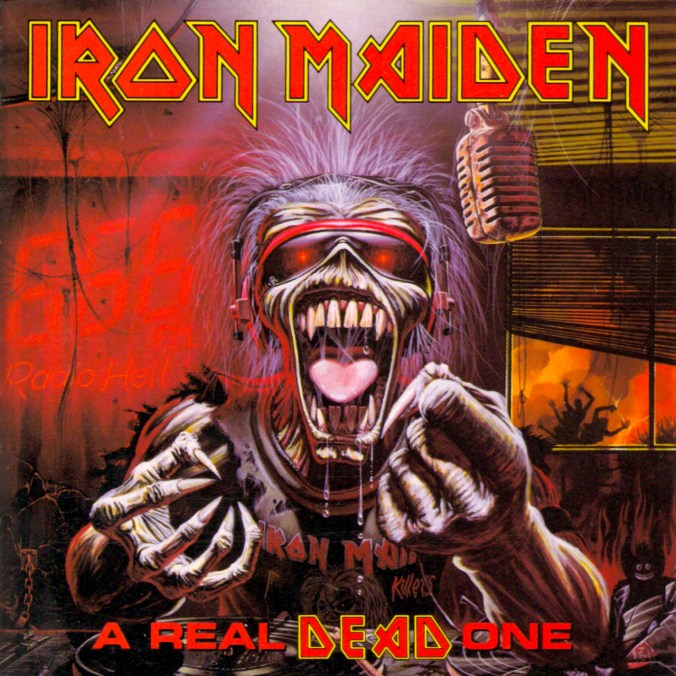
The live album onslaught of 1993 continued in the fall of the year. But the production and performances of Iron Maiden at the end of the first Dickinson period do not hold up well.
A Real Dead One
Produced by Steve Harris
Released 18 October 1993
It started with A Real Live One early in the year. And then the second live album of 1993, A Real Dead One, had its premise altered when singer Bruce Dickinson announced his decision to leave the band. The setlist for his final tour was reworked to include some rarely-heard gems, and the band recorded more shows.
The inclusion of older and rarer songs in the show must certainly have been a treat for the fans: Prowler, Transylvania, Remember Tomorrow and Where Eagles Dare hadn’t been heard for years, and it’s nice to finally have them included on a live album. Sadly, Steve Harris’ production does not do justice to the material by a long shot. The sound is thin, dry, and tough on the ears, just like the predecessor. The loss of producer Martin Birch to retirement would haunt Maiden for years.

The Iron Maiden line-up that recorded the 1993 live albums: Janick Gers, Steve Harris, Bruce Dickinson, Nicko McBrain and Dave Murray.
The choice of album title is disastrous, drawing attention to the terrible sound mix and the potential death of Maiden upon Dickinson’s exit. It is frankly impossible to understand why Maiden went with this title, it having no pun or joke that would be even remotely funny for band and fans at that time.
But the worst thing about this is the production.
One problem is the way the bare-bones mix sheds unforgiving light on the guitar work. It becomes obvious that Dave Murray and Janick Gers’ double Strat attack is flat in tone when compared to the Les Paul counterpoint that both Adrian Smith and Dennis Stratton had earlier provided. And without Smith, Maiden have lost a lot of their power, subtlety and melodic sensibility, becoming more punkish and off-the-wall in their approach to live performances. This hurts material like 2 Minutes To Midnight and Hallowed Be Thy Name, and it could be seen as mercy on Harris’ part that he left Wasted Years off the album for use as a B-side.

Dickinson and Harris on stage for the Maiden tour they both probably would like to forget.
Another audio problem with all of Harris’ Barnyard Studios production work in 1993 is his desire to have a lot of audience noise in the mix. This leads him to turn up the audience microphones at choice moments, letting the hall ambience bleed into the mix, which includes the sound of the band from the front-of-house PA. When the audience microphones are then turned down or taken out, it’s a painful return to the dry-as-sandpaper sound of the band only. It sounds utterly amateurish.
There is also a frustrating lack of cohesion and atmosphere to an album with songs recorded in many different cities and put together outside of the concert sequence in which they were performed. Unlike the immediate successor Live At Donington, A Real Dead One gives no sense of the flow of a 1992-93 Iron Maiden show.

The single off A Real Dead One was a not-very-impressive Hallowed Be Thy Name, and even the joke of Eddie impaling Dickinson in the Derek Riggs cover art only served to illustrate that Maiden were in serious trouble.
So, the album boasts a very good batch of songs, some that had never been on a Maiden live album and hadn’t been performed in years. But all is neutered by imprecise performances and a powerless production that takes away the potential depth of the music and leaves the listener not wanting to give the album another spin.
When classic material is presented this way, Maiden becomes something close to a parody of themselves. One can actually understand why Dickinson felt the urge to go elsewhere at that point in time.
Christer’s verdict: 2/6
6/6 Masterpiece
5/6 Great
4/6 Good
3/6 OK
2/6 Disappointing
1/6 Crap
 Maiden Revelations
I became a huge fan of the band shortly after the release of Fear Of The Dark. I loved the rawness and the Rock’n’Roll attitude of NPFTD and FOTD era and of course I loved A Real Live One too. I still think A Real Live One is an ok live album, as the flaws that are apparent in its successor aren’t as pronounced. I also like the focus on newer material. I’m sick and tired of hearing the classics on the recent live albums. I tried hard to like A Real Dead One, but I can’t recall the last time I gave it a spin. I gave it a quick listen after reading your review and your criticism is spot on! The use of the audience microphones is comical at times, the guitars sound paper-thin (well, they did from 1986 onwards…) and the band as a whole sounds like a mess. Nevertheless: if you had said that to my face back in the day, I would have thrown some puny punches 😀 The cover is still cool though.
I never got the criticism for a Real Live and Dead one and a Real Dead one that much to be honest! I got into Maiden via No Prayer and Fear of the Dark at the age of 13 and these were the first two releases that came out once I’d discovered them. I saved up my paper round money to buy them so and was thrilled with them; with the benefit of hindsight I can see the production is a little thin but to my 13 year old ears that had feasted on nothing heavier than Roxette previously it was cutting edge stuff. Actually my 41 year old ears quite like it still as well! As a side note if there’s one period in my life I wish I could revisit it’d be getting into Maiden via their 90s output and then filling in the 80s albums afterwards. I though all the 90s stuff was mindblowing, can you imagine how I felt when I picked up on Piece of Mind etc?! Love this site although it’s derailing my productivity at work a bit. Stay safe everyone!
For a long time, I also viewed the production of this album as lacking, but over time, my appreciation for it, and the album overall, has considerably increased. Today, I appreciate the direct guitar sound, where, similar to Live After Death, one can hear each nuance in Dave’s and Janick’s performance. I also appreciate the honest sound both of the guitars and the rest of the band—this is how the band really sounds live, and I am grateful that the band put this album out, rather than a highly polished version.
I do not think that the sound that the author of this article referred to as flat has much to do with fact that both Dave and Adrian played strats, but rather with the less restrained playing style of Janick. In addition, this was a period when Maiden embraced super fast video editing, changed their stage outfits from spandex to denim and t-shirts, and adopted an overall rawer sound and approach to performing, presumably in an effort to appear younger and cooler and to compete with the slew of young grunge bands that were dominating the media at the time. Bruce’s outfit for that tour was something that would not have been out of place in some of the younger bands of the time.
Another thing that I enjoy about this album is the setlist. Yes, we get all the staple classics, but we also get a ton of other rare gems on an official live album, whether those be from the classic era on A Real Dead One (“Prowler”, an unabridged version of “Where Eagles Dare”, “Remember Tomorrow”, “Transylvania”, “Sanctuary”), to the songs form the newer albums on A Real Live One (“Tailgunner”, “Bring Your Daughter to the Slaughter”, “Holy Smoke”, “Wasting Love,” “Afraid to Shoot Strangers”, “Fear of the Dark”). For fans who are tired of the lack of variety of post-2000 Maiden live albums, A Real Dead One and its twin A Real Live One represent a wonderful trove of interesting songs to enjoy, even to this day.
Speaking of enjoyment, one more thing I appreciate on this album is how good some live versions of the songs are. Personally, I think this version of “Sanctuary” is excellent, as is “The Trooper.” From its twin A Real Live One, I think the Seventh Son of a Seventh Son material is outstanding, and the live version of “Fear of the Dark” is energetic and with the audience chanting along, a classic. I like how the music on both these live albums has a cool mood, energy, or whatever one wants to call it.
I can assure you that I mean exactly what I write about guitar tones. Obviously Gers’ style influences the overall tone, but it’s just as obvious that the tone changes when you take every guitar except the Fender Stratocaster out of the mix. This flattening of tone, by which I mean less complimentary contrast between the two guitar players’ sounds, was audible even on the Birch productions (‘No Prayer’ and ‘Fear of the Dark’).
Personally I find the ‘A Real Dead One’ mix to be terrible in general, but the guitar tone question (contrast, depth and dynamic range) is overwhelmingly clear when you compare this to either what came before (‘Live After Death’) or what came after (maybe particularly the Shirley mixes of ‘Flight 666’ and ‘En Vivo!’).
It’s super cool that you enjoy these 1993 live albums, and I also find it slightly easier to listen to them now because they don’t matter in the way they did when they were brand new. The energy is undeniable, and I personally prefer the ‘Live at Donington’ recording because of the Dickinson, Harris and McBrain performances there.